
You might have a solid personal credit score and still get turned down for a business loan. That happens more often than most people expect, and it catches new entrepreneurs off guard. Personal credit and business credit are two separate systems, and lenders, suppliers, and investors look at both. If you're building or planning to launch a business, understanding how business credit works is one of the most practical steps you can take to protect your financial future and access the funding you need to grow.
Table of Contents
- What is business credit and how does it work?
- Why business credit matters for entrepreneurs
- How business credit is used in startup funding
- Steps to build strong business credit
- A fresh take: what most guides miss about business credit
- Connect your business credit goals with helpful resources
- Frequently asked questions
Key Takeaways
| Point | Details |
|---|---|
| Business vs personal credit | Business credit is separate from personal credit and helps determine your eligibility for loans and partnerships. |
| Major credit bureaus | The main business credit bureaus use different scoring methods, so checking all reports is vital. |
| Impact on funding | Strong business credit can improve access to loans, better insurance rates, and vendor relationships. |
| Building steps | Register your business, open accounts, and use credit responsibly to build a foundation. |
| Monitor and apply | Monitoring your credit and applying practical strategies can give your business an edge. |
What is business credit and how does it work?
Business credit is a record of how your company manages its financial obligations. It tracks whether your business pays its bills on time, how much debt it carries, and how long it has been operating. Think of it as your company's financial reputation, separate from your personal history.

The key difference between business and personal credit is ownership. Personal credit is tied to your Social Security number and reflects your individual borrowing behavior. Business credit is tied to your company's Employer Identification Number (EIN) and reflects how the business itself handles money. Lenders and vendors use this information to decide whether to extend credit, set payment terms, or approve funding.
Business credit is typically reported and scored by multiple business credit reporting agencies, each using its own scoring model. This is different from personal credit, where FICO dominates and most lenders use a single score range of 300 to 850.
Main business credit bureaus
Here are the primary agencies that track and report business credit:
- Dun & Bradstreet uses the PAYDEX score, which ranges from 0 to 100 and focuses on payment history
- Experian Business uses the Intelliscore Plus, which also ranges from 0 to 100
- Equifax Business uses a credit risk score ranging from 101 to 992
- FICO SBSS (Small Business Scoring Service) ranges from 0 to 300 and is commonly used by the SBA for loan decisions
Business credit scoring models at a glance
| Bureau | Score name | Score range | Primary focus |
|---|---|---|---|
| Dun & Bradstreet | PAYDEX | 0 to 100 | Payment timeliness |
| Experian Business | Intelliscore Plus | 0 to 100 | Risk prediction |
| Equifax Business | Credit Risk Score | 101 to 992 | Financial stability |
| FICO SBSS | Small Business Score | 0 to 300 | Overall creditworthiness |
Pro Tip: Pull your business credit reports at least once a quarter. Errors or outdated information can drag your score down without you realizing it, and correcting them takes time.
Why business credit matters for entrepreneurs
Once you understand what business credit is, it's crucial to know why it matters for anyone launching or growing a business. The impact goes well beyond getting a loan approved.
Lenders use your business credit profile to assess risk before approving financing. A strong profile signals that your company is reliable and financially responsible. A weak one raises red flags, even if your personal credit is excellent. The two systems don't cancel each other out. They're evaluated separately, and gaps in your business profile can cost you real opportunities.
"Poor credit history is a common reason small-business loan applications are declined," according to SBA guidance on business credit. This is one of the most preventable reasons entrepreneurs lose access to capital.
Business credit also affects your relationships with suppliers and vendors. Many suppliers run credit checks before offering net payment terms, which means they want to see your business's track record before letting you pay 30, 60, or 90 days after delivery. Without strong business credit, you may be required to pay upfront, which ties up cash flow and limits your operational flexibility.
Insurance companies sometimes factor in business credit when setting premiums for commercial policies. A lower business credit score can translate to higher monthly costs, which adds up over time and cuts into your margins.
Consequences of poor business credit
- Loan applications get declined or approved at higher interest rates
- Suppliers require upfront payment instead of flexible net terms
- Business insurance premiums may increase
- Potential partners or investors may view your company as a higher risk
- You may be forced to use personal credit, which puts your personal finances at risk
- Growth opportunities that require fast capital access become harder to act on
You can explore real-world credit examples to see how these consequences play out across different business types and industries.
How business credit is used in startup funding
With the importance established, let's look at how business credit is actually put to work during the startup or funding process.
Building and using business credit is connected to startup funding behavior, and the data reveals a clear pattern between business structure and how founders access capital. Businesses with employees (called employers) tend to rely more heavily on business credit products, while solo operators and freelancers (called non-employers) lean on personal credit cards and personal savings.
This matters because the funding sources available to you often depend on how your business is set up and what kind of credit profile it has. A sole proprietor with no business credit history has fewer options than an LLC with two years of on-time payment history and active business accounts.
Startup financing sources: employers vs. non-employers
| Financing source | Employers | Non-employers |
|---|---|---|
| Business credit cards | High usage | Low usage |
| Personal credit cards | Moderate usage | High usage |
| Business bank loans | Common | Less common |
| Personal savings | Common | Very common |
| SBA loans | Accessible with business credit | Harder to qualify |
| Outside investors | More accessible | Limited access |
Advantages of using business credit instead of personal credit for funding
- Keeps your personal credit score protected from business debt
- Allows you to access higher credit limits designed for business expenses
- Builds a separate financial track record that grows with your company
- Makes it easier to qualify for larger loans and lines of credit over time
- Reduces personal liability if the business faces financial difficulty
- Positions your business as a credible entity to lenders and investors
Consider this scenario: two entrepreneurs both need $50,000 to fund inventory for their product launch. One has been building business credit for 18 months with a dedicated business account, vendor trade lines, and a business credit card paid on time. The other has only personal credit. The first entrepreneur qualifies for a business line of credit at a competitive rate. The second either gets declined or uses a personal loan at a higher rate, which affects their personal debt-to-income ratio. Same goal, very different outcomes.
You can see more examples of business funding with credit and how different entrepreneurs have used their business profiles to access capital at the right time.
Steps to build strong business credit
Now that you understand how business credit is used, let's break down the steps to start building your own. This is where knowledge turns into action.
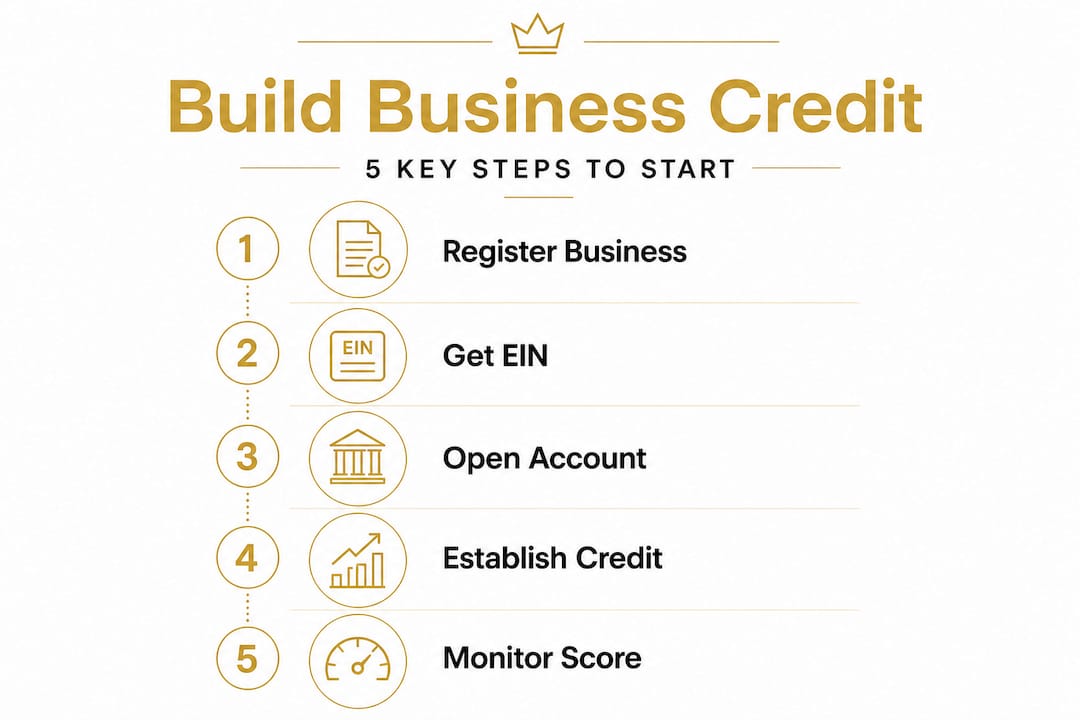
The process takes time, but each step compounds. A business that consistently follows these steps will have a meaningful credit profile within 12 to 24 months.
The step-by-step process
-
Register your business as a legal entity. Form an LLC or corporation to separate your personal and business identities. This is the foundation. Without it, your business activity may still be tied to your personal credit.
-
Get an Employer Identification Number (EIN). Apply for an EIN through the IRS website at no cost. This is your business's tax ID and the number used to open accounts and build your business credit file.
-
Open a dedicated business bank account. Use it exclusively for business income and expenses. This creates a clear financial record and is often required by lenders before they'll consider a business loan application.
-
Get a dedicated business address and phone number. Many credit bureaus and lenders verify that your business is legitimate. A business phone number listed in directory services and a consistent address strengthen your credibility.
-
Open vendor trade lines. Work with suppliers that report payment activity to business credit bureaus. Paying these accounts on time is one of the fastest ways to build a positive business credit history. Office supply companies and fuel card providers are common starting points.
-
Apply for a business credit card. Use it for regular business purchases and pay the balance in full each month. This builds payment history and demonstrates responsible credit use. Start with cards designed for new businesses or those with limited credit history.
-
Monitor your business credit reports. Check reports from Dun & Bradstreet, Experian, and Equifax regularly. Dispute any errors immediately. Poor credit history can affect access to funding and supplier relationships, so keeping your reports accurate is essential.
-
Pay every account early or on time. The PAYDEX score from Dun & Bradstreet actually rewards businesses that pay before the due date. Paying 10 to 15 days early can push your score higher than simply paying on time.
Pro Tip: Never mix personal and business finances. Even one or two personal charges on a business account can complicate your records, create tax issues, and blur the separation that lenders look for when evaluating your business credit profile.
Explore the steps for building business credit in more detail to get a clearer picture of how to apply each of these actions to your specific situation.
A fresh take: what most guides miss about business credit
Most articles on business credit stop at the basics: register your business, get an EIN, open a business account. That advice is correct, but it's incomplete. The part that rarely gets discussed is what happens after you establish credit.
Here's the honest truth. Building business credit is not a one-time project. It's an ongoing practice. Many entrepreneurs do the setup work, get a business credit card, and then go months without checking their reports or actively managing their profile. That's where things quietly fall apart.
Errors on business credit reports are more common than most people realize, and unlike personal credit, you don't always get automatic alerts when something changes. A vendor might report a late payment incorrectly. A new account might not show up at all. If you're not monitoring your reports consistently, you won't know until it costs you something.
The other thing most guides skip is supplier negotiation. Once your business credit is established, you have real leverage. You can approach vendors and ask for better net terms, higher credit limits, or lower deposit requirements. Most business owners don't do this because they don't realize their credit profile gives them that power. Treating your business credit like a static number rather than an active tool is a missed opportunity.
Here's the contrarian angle worth considering: using personal credit in the very early days of your business is not always a mistake. If you're pre-revenue and have strong personal credit, it can help you get started while you build your business profile. The key is to transition deliberately and quickly. Set a clear milestone, such as reaching $5,000 in monthly revenue or completing your first six months of operation, and then shift your focus fully to business credit. Don't stay on personal credit longer than necessary.
The businesses that build lasting credit profiles are the ones that treat it like a living asset. They monitor it, protect it, and use it strategically rather than reactively.
Connect your business credit goals with helpful resources
Understanding business credit is one thing. Putting it into practice is another, and that's where having the right support makes a real difference.

At Lifestyle LLC, we help everyday entrepreneurs build the financial foundation they need to grow with confidence. Whether you're just starting out or looking to strengthen an existing business credit profile, our business credit solutions are designed to give you practical tools, step-by-step guidance, and real strategies that work. From credit building resources to business funding education, we're here to help you move forward with clarity and purpose. Explore what's available and take the next step toward building the business you've been working toward.
Frequently asked questions
How is business credit different from personal credit?
Business credit tracks your company's financial behavior, while personal credit reflects your individual history. Business credit is reported by specialized agencies like Dun & Bradstreet, Experian Business, and Equifax Business, each using their own scoring systems.
What hurts business credit the most?
Late payments, high debt utilization, and inconsistent financial records are the most damaging factors. The SBA notes that poor credit history is one of the top reasons small-business loan applications get declined.
Is business credit required to get startup funding?
Most lenders prefer to see a strong business credit profile, but some startups can use personal credit early on. According to the QuickBooks Small Business Financing Report 2025, non-employers rely more on personal credit cards and savings, while employers tend to use business credit products.
How do I check my business credit score?
You can check your scores directly with Dun & Bradstreet, Experian Business, and Equifax Business. Business credit scores are tracked separately from personal scores, so you'll need to access each bureau individually to get a full picture.